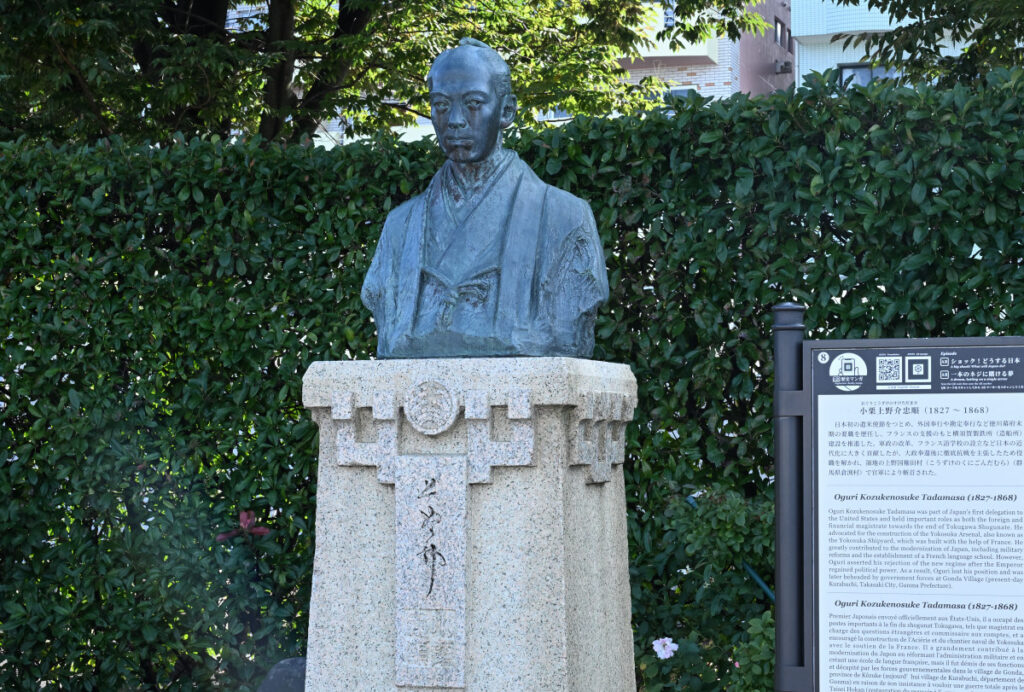
This begins with that content.
Oguri Tadamasa’s (Oguri Bungo no kami, later Kōzuke no suke) strategy was not adopted under Tokugawa Yoshinobu. It concerns the time after the battle with the Shōgitai at Ueno had ended, in the 4th month of Keiō 4 (1868). The staff officers and military inspectors of the government army, including Ōmura Masujirō and Etō Shinpei, gathered together. There Ōmura let slip that if the shogunate had carried out that plan, their own lives would not have been spared. Ninagawa Arata quotes this scene from Iohara Ryūjirō and Kimura Tomoharu’s co-authored “Count Hijikata.”
The strategy that Ōmura conveyed was as follows. It was calculated that the forces sent to subdue the Kantō, with Arisugawa no Miya as commander-in-chief, would not exceed 30,000 men. Open the barrier at Hakone, let the entire government army enter Edo, and then close Hakone off. In the direction of the Tōsandō, block the Kiso road, and once the enemy is shut in, fighting them would make wiping them all out easy. Half the warships would hold down Suruga, and the remaining half would attack Settsu Bay.
If that happened, Oguri judged, most of the daimyo of the Kantō would side with the Tokugawa house. In the Kansai too there were fudai daimyo and shinpan houses, and even among the tozama there were some inclined toward the shogunate. A way to restore the Tokugawa house would then open up—this was Oguri’s argument. That day’s deliberation settled on this course, and everyone withdrew from the castle. But when day broke, the decision was overturned, and those who had sided with Oguri were even stripped of their posts.
Ōmura is said to have remarked that, enemy though he was, it was a pity—so Ninagawa records. At this point Etō interjected. Once a decision is made, the assignments must be given out on the spot and announced at once. If people go home in a daze and fall asleep, there is no way it can be carried out—this was his argument. Those who heard it were all struck by its swiftness, Ninagawa writes.
Ninagawa does not take Etō’s argument at face value. Oguri was not the shogun, and was not in a position to carry policy through as he wished—this is the point Ninagawa makes. Miyake judged that no one matched Oguri in resourcefulness and daring, and that Katsu Kaishū came close only to some degree. On the 25th day of the 4th month, Kondō Isami, captured at Itabashi, was beheaded, and his head was sent to Kyoto and exposed there. As for those who exposed the innocent Oguri, father and child, together with his six retainers, Ninagawa writes that the judgment the people render has no statute of limitations.
Ninagawa also records the dignified conduct Oguri showed at age 14 when he visited Takebe Masaatsu’s residence. He writes that even at cherry blossom viewing Oguri spoke only of the river’s water management, that before his execution he did not touch his meal, and that he was beheaded without his expression changing. In Taishō 4 (1915), a celebration marking the 50th anniversary of the founding of the shipyard was held in Yokosuka. A small bust was to be erected in the park. Over the 45 years of Meiji, not a single document recognizing his achievements was issued in the name of any government office, Ninagawa writes. Had Oguri’s words been heeded by Yoshinobu, the outcome would have been different—this is Ninagawa’s conclusion.
From the plan to open and then close Hakone, through the deaths of Oguri and his son, to the bust erected in Taishō 4, the reader can follow the story through quotations from “Count Hijikata,” Miyake’s preface, and the accounts Ninagawa Arata heard as a boy from former retainers.
The crisis threatening Ōmura Masujirō’s life
It was in Keiō 4 (1868), after the fighting against the Shōgitai at Ueno had ended.OriginalOriginal
Ōmura Masujirō, Etō Shinpei, and other staff officers and military inspectors of the government army had gathered and were talking over various matters.OriginalOriginal
At that point Ōmura spoke up.OriginalOriginal
He said that if the shogunate had adopted and actually carried out the plan proposed by Oguri Bungo no kami (later Kōzuke no suke), “we would probably have had almost no chance of surviving.”OriginalOriginal
Please consult the original page images for this source.
Open the original page at the National Diet LibraryThis meant that they themselves would probably not have survived.OriginalOriginal
Ninagawa Arata records this scene, quoting from Count Hijikata (co-authored by Iohara Ryūjirō and Kimura Tomoharu, pages 398 to 402).Original
Ninagawa notes that the book was compiled with the approval of Hijikata Hisamoto.OriginalOriginal
Letting thirty thousand men into Edo
The plan of Oguri’s that Ōmura described was as follows.OriginalOriginal
It had been decided that Arisugawa no Miya would become commander-in-chief and lead the subjugation of the Kantō region, but the troops he commanded would “surely not exceed thirty thousand.”OriginalOriginal
This was the estimate: that the number would not exceed thirty thousand.OriginalOriginal
The plan was to “open the barrier gate at Hakone and let the government army pour into Edo,” and then close off Hakone afterward.OriginalOriginal
On the Tōsandō side, the Kiso road would be blocked.OriginalOriginal
Once the entire government army had been let into Edo, fighting them there would make it easy to annihilate them completely.OriginalOriginal
Furthermore, half the warships would hold down Suruga, while the other half would strike into Settsu Bay.OriginalOriginal
If this were done, most of the lords of the Kantō region would side with the Tokugawa house.OriginalOriginal
If this affair were regarded as a second Sekigahara, then in the Kansai region too there were hereditary daimyo and related-house daimyo, and even among the outside lords there were surely not none who felt sympathy for the shogunate.OriginalOriginal
Oguri’s argument was that a path to the restoration of the Tokugawa house would then open up.OriginalOriginal
The deliberations of that day settled on this course, it was decided to carry it out according to Oguri’s plan, and everyone withdrew from the castle.OriginalOriginal
Please consult the original page images for this source.
Open the original page at the National Diet LibraryBut when dawn came, within a single night the decision had been overturned.OriginalOriginal
Oguri’s faction and those who had supported him were even stripped of their official duties.OriginalOriginal
Ninagawa records that Ōmura said, “Even as an enemy, it truly was a pitiable outcome.”OriginalOriginal
Etō Shinpei’s quick wit and Ninagawa’s criticism
In response to that remark, Etō Shinpei broke in.OriginalOriginal
Someone objected, saying what was so foolish about it.OriginalOriginal
At such a moment of crisis threatening survival itself, one must not entertain such leisurely thoughts.OriginalOriginal
Once a decision had been reached, the disposition of forces should have been fixed on the spot at once, with orders given as to who would take which troops against which direction, and it should have been announced immediately.OriginalOriginal
To go home vaguely and sleep peacefully like fools—such men could surely never have carried it out.OriginalOriginal
It is said that all who heard this were struck by Etō’s quickness of mind.OriginalOriginal
Ninagawa, however, does not take Etō’s criticism at face value.OriginalOriginal
Oguri was not the shogun himself.Original
In the era of Tokugawa Yoshinobu, politics did not move easily according to Oguri’s wishes.OriginalOriginal
Ninagawa calls it a flippant remark born of sour grapes.OriginalOriginal
What interests him more, in judging Oguri’s character, is the fact that Ōmura—the one true military strategist on the Satsuma-Chōshū side—had honestly confessed his astonishment.Original
That is how Ninagawa sees it.OriginalOriginal
Please consult the original page images for this source.
Open the original page at the National Diet LibraryMiyake Setsurei’s “none at the time could stand beside him”
Andō had tried by whatever means to unify the country and confront the rival great powers, but customs of long standing could not be reformed suddenly.Original
The related houses, hereditary vassals, and outside lords were entangled with one another, and toward the senior councilors it was “as if there were many meddling in-laws”—a situation like having several sisters-in-law all at once.Original
If things went smoothly it was taken for granted, but if any trouble arose there was an uproar of blame.Original
And so it was that “the victor becomes the government army, the loser becomes the rebel.”Original
Miyake says this.Original
Was there anyone who could rival Oguri in resourcefulness and courage?Original
Katsu came somewhat close, but the others fell far short.Original
“It is, I fear, the difference between a hawk and a kite.”Original
That is to say, the gap was as great as that between a hawk and a kite.Original
And “none at the time could stand beside him”—meaning that in his day no one equaled Oguri.Original
Yet the fact that his name is scarcely heard of now is chiefly because he was killed by the government army.Original
Ninagawa supports this view of Miyake’s, calling it “a fair judgment of the two men, made impartially from a broad and lofty perspective.”OriginalOriginal
Please consult the original page images for this source.
Open the original page at the National Diet LibrarySending the head all the way to Kyoto
Ninagawa also touches on the matter of Kondō Isami.OriginalOriginal
On the twenty-fifth day of the fourth month of Keiō 4, he was captured by the government army at Itabashi and beheaded.Original
His head was sent all the way to Kyoto and exposed there.OriginalOriginal
After Yoshinobu’s submission, Kondō had obtained military funds from Katsu Kaishū and fought the government army in Kōshū.Original
Ninagawa too acknowledges that he deserved punishment.OriginalOriginal
Even so, to deliberately send his head to be exposed in Kyoto, the very city where Kondō had once been active, was surely not something befitting an imperial army—following Yamakawa Kenjirō, who in the preface to Nagakura Shinpachi Den, published in the sixth month of Shōwa 2 (1927), argued that it was “an instance of private grudges being repaid,” Ninagawa places the blame on the staff officer Kagawa Keizō and others.OriginalOriginal
Please consult the original page images for this source.
Open the original page at the National Diet LibraryWhat of those who exposed the heads of Oguri Kōzuke no suke and his son—men far superior in character, who held a vital position for the nation, who had rendered real service, and against whom there was no trace of wrongdoing or resistance—along with their six retainers, and what of those who gave the order?OriginalOriginal
“Though there is a statute of limitations under the law, there is no such thing as a statute of limitations for the judgment of the people.”OriginalOriginal
In other words, even though legal liability may lapse with time, the verdict rendered by the people never does.OriginalOriginal
Hoofbeats at Surugadai, water management along the Bokutei
Ninagawa wrote down in detail Oguri’s character, based on accounts he heard as a child.OriginalOriginal
Oguri’s wife was the daughter of Takebe Takumi no kami, the domain lord of Banshū Hayashida with a stipend of ten thousand koku.Original
Former domain retainers reportedly told Ninagawa, in his boyhood, about the time Oguri went to pay his respects to Takebe Masaatsu.OriginalOriginal
Oguri was still fourteen years old.Original
When he first came as a guest to the Takebe residence, his bearing was entirely that of an adult, his speech clear, his voice resonant.OriginalOriginal
He smoked tobacco, striking the tobacco tray sharply, as he exchanged questions and answers with the domain lord.OriginalOriginal
Everyone, astonished at his arrogance, wondered aloud what kind of man he would become.OriginalOriginal
The house of Ninagawa Sagami no kami stood in Kanda Nishikichō, and Oguri’s house stood in Surugadai.Original
Every morning when he went to the castle, Oguri passed in front of the retainers’ quarters of the Ninagawa house.OriginalOriginal
An old man named Moriyama Kyūhei, a former retainer, told this to Ninagawa in his childhood.OriginalOriginal
Oguri never went to the castle by palanquin, but always on horseback.Original
Even hidden inside the house, one could tell from the sound of the horse’s hooves, “This is Lord Oguri going to the castle.”Original
It was his custom to always ride a fine horse, and the sound of its hooves was quite unlike that of any other horse.OriginalOriginal
There was a time when, invited by Asahina Kansui, who had served as commissioner of foreign affairs, he went by pleasure boat to view the cherry blossoms at Bokutei.OriginalOriginal
Oguri paid no attention to the cherry blossoms, the sake, or the beautiful women, and spent the whole time talking only of such things as whether that stretch of river was good for water management, whether that weir would be better if raised a little higher, or perhaps lower, and how the irrigation of the paddies here and there served the people’s livelihood.OriginalOriginal
He seemed to have completely forgotten that he was a guest at a flower-viewing party.OriginalOriginal
He Did Not Touch the Meal Before His Execution
Regarding paintings and calligraphy, Ninagawa relates that Oguri said the following.Original
Whether one calls a work Song or Ming, no one actually witnessed its creation; it is merely the conjecture of appraisers.Original
To prize above all else something whose authenticity is unknown shows a lack of judgment.OriginalOriginal
So he had the noted masters of his own time paint or write in front of him, and only after confirming a work was genuine did he treasure it.OriginalOriginal
Ninagawa dismisses as an incredible rumor the story that three million five hundred thousand ryō were buried on Mount Akagi.Original
It is said that after he was killed, only two pieces of gold he had received as a gift remained at the temple where he had been living.OriginalOriginal
When he was about to be beheaded, the men of the government army, following the custom of what was served to those sentenced to death, brought out a meal tray with three pieces of accompanying food.OriginalOriginal
Oguri did not touch it.OriginalOriginal
It is said this was because he thought it would be a disgrace to a warrior if even a grain of rice remained in his throat at the moment of beheading.OriginalOriginal
And, with “perfect composure” — without his expression changing in the least, without fear, without hesitation, resenting no one — he calmly had his head cut off.OriginalOriginal
Please consult the original page images for this source.
Open the original page at the National Diet LibraryA Declaration Fifty Years Later
In Taishō 4 (1915), a celebration was held in Yokosuka marking the fiftieth anniversary of the founding of the shipyard.Original
This was in recognition of Oguri’s achievement in overcoming strong opposition to bring about the establishment of the shipyard.Original
After fifty years, a portion of that achievement was finally spoken of publicly.Original
Ninagawa writes that throughout the forty-five years of Meiji, no official document was ever issued in the name of the authorities acknowledging Oguri’s achievements.Original
Only two men, Fukuchi Gen’ichirō and Shimada Saburō, are said to have worked quietly on his behalf.Original
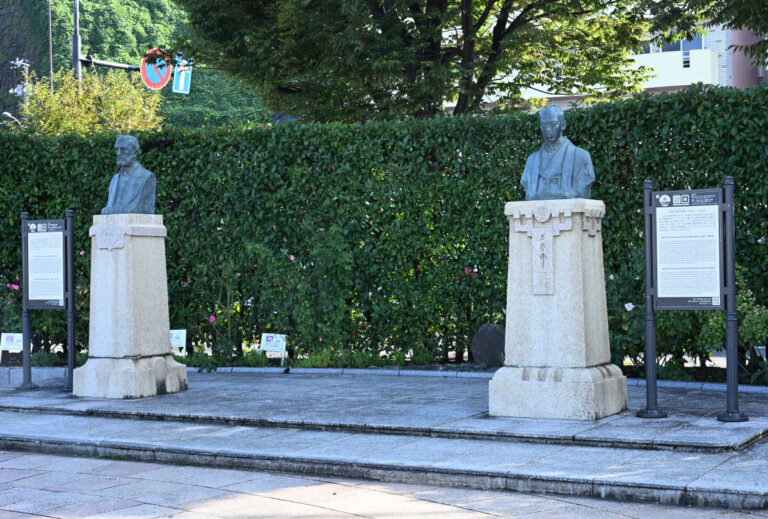
Eventually a bust of Oguri came to be erected in a park in Yokosuka.Original
Ninagawa adds that it was an extremely small one.Original
Two hundred yen was granted by the Empress toward the cost of the bronze statue, and Ōmori, the master of the Empress’s household, visited the Oguri family to convey her wishes.Original
That same Ōmori is said to have told a member of the Oguri family the following.Original
I too had in the past heard that Oguri Kōzuke no suke was not a good man, but as a result of investigation I came to learn that he was a meritorious servant of the nation.Original
Ninagawa writes of this as an example of a “trial in absentia.”Original
Judging a person having heard only one side’s ill repute, without hearing both sides of the story.Original
There is a great deal of this sort of thing in the world, he writes.OriginalOriginal
Please consult the original page images for this source.
Open the original page at the National Diet LibraryA Decision Overturned in a Single Night
Ninagawa’s writing is directed, from beginning to end, at a single point.OriginalOriginal
That point is this: what if Oguri’s advice had been followed by Yoshinobu.OriginalOriginal
Tokugawa Yoshinobu would have been spared the humiliation of surrendering to Satsuma-Chōshū, and could have brought the restoration of political power to a splendid conclusion.Original
The feudal system would have been abolished at once, just as Oguri had long argued, without having to wait until Meiji 4 (1871).OriginalOriginal
“On the life or death of Oguri alone hinged the success or failure of this momentous outcome,” he writes.OriginalOriginal
Some readers may wonder whether it is right to place so much weight on one man alone.
Both Miyake’s preface and Ninagawa’s judgment can be read as resting on a deep distrust of the compilation of records by the victorious side.OriginalOriginal
Please consult the original page images for this source.
Open the original page at the National Diet LibraryStill, the one remark that Ōmura Masujirō let slip to his peers carries weight, coming as it does from the mouth of the opposing side.OriginalOriginal
The debate had been settled.Original
Everyone left the castle.OriginalOriginal
And within the few hours before dawn, it had been overturned.OriginalOriginal
Places connected with this article
| Source text | Ishin zengo no seisō to Oguri Kōzuke no shi (1928). National Diet Library Digital Collections (PDM). PID 1876405 |
| Dates and names | All 1 dates in the text exist in the calendar for their year, and the Western years given alongside them agree. The 4 people named in the text were checked word for word against the source text. No entries have been prepared yet for vol. 8, so no comparison with it was made. |
| English gates | 113 of 113 sentences passed the checks on the English text. |
This article is a reading of Ishin zengo no seisō to Oguri Kōzuke no shi. Ninagawa Arata’s books (1928-31) are written from the standpoint of the shogunate’s retainers. The source text is a century old and may differ from current scholarship.